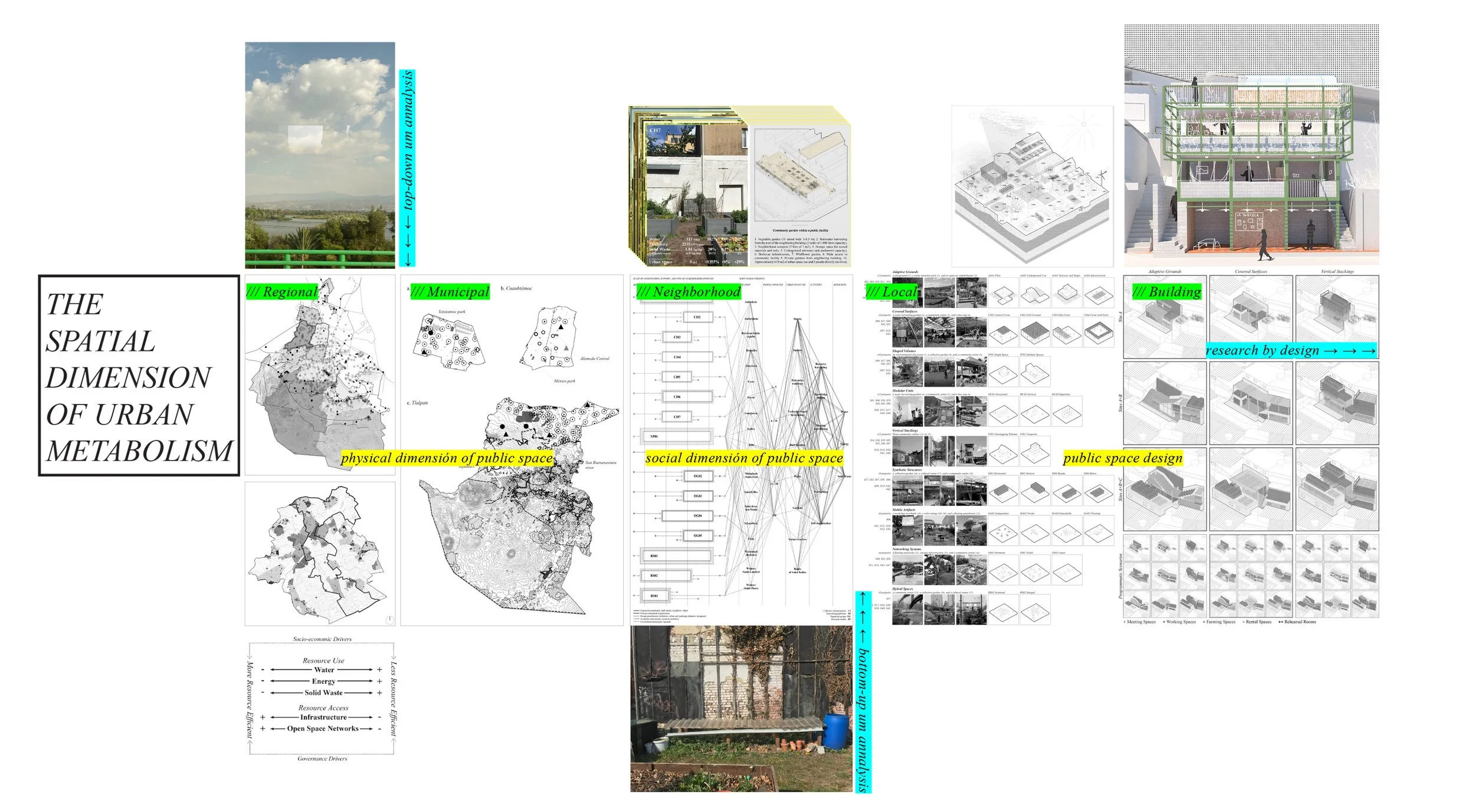
Urban metabolism (UM) studies offer critical insights for enhancing resource efficiency in cities. Over recent years, these studies have adopted an interdisciplinary and multiscale perspective, with a growing focus on the socioeconomic contexts, power dynamics among stakeholders, and the ecological connectivity of urban areas. Localizing and quantifying urban flows and stocks are particularly valuable for identifying infrastructure deficiencies and disparities in resource accessibility, especially among vulnerable communities. However, only a limited number of such studies include spatially explicit data to inform design practitioners effectively. This research examines the spatial dimension of UM as applied to urban planning and design across diverse social and geographical contexts and at varying scales of resource infrastructure. In particular, by applying spatially explicit UM analysis as a diagnostic tool, including geographic and socio-ecological inputs, to understand how can public space design contribute to the resource efficiency and community involvement in urban environments. To this end, the study comprises three research projects, each employing distinct methodologies, case studies, and intervention scales: (i) mapping of resource efficiency hotspots at the city scale, (ii) illustrating and analyzing socio-ecological dynamics at the community scale, and (iii) developing a spatially explicit catalogue of resource-sensitive urban archetypes and design tools. These projects are supported by an extensive literature review, collection of primary spatial data, analysis of existing datasets, field visits, and interviews with main stakeholders. The findings highlight the potential to integrate resource use management across multiple scales, from localized urban systems to broader regional networks. This research advances a combined top-down and bottom-up analytical approach, merging conceptual frameworks with practical tools to enhance the applicability of UM studies for design practitioners. This dual perspective aims to bridge the gap between theoretical insights and the pragmatic demands of urban planning and design.
. Otero Peña, D., & Perrotti, D. (2026). Resource-sensitive and community-inclusive urban archetypes to enhance the applicability of urban metabolism frameworks by design practitioners. Environmental Research: Infrastructure and Sustainability. 6(2), 025003. https://doi.org/10.1088/2634-4505/ae5a58
. Otero Peña, D., Perrotti, D., & Vanderstraeten, P. (2026). Design insights for resource-efficient and community-inclusive urban spaces: Learning from the metabolism of alternative resource governance systems in Brussels. Cities, 173, 106930. https://doi.org/https://doi.org/10.1016/j.cities.2026.106930
. Otero Peña, D., Perrotti, D., & Mohareb, E. (2022). Advancing urban metabolism studies through GIS data: Resource flows, open space networks, and vulnerable communities in Mexico City. Journal of Industrial Ecology, 26(4), 1333-1349. https://doi.org/https://doi.org/10.1111/jiec.13261
. Perrotti, D., Moosavi, S., & Otero Peña, D. (2023). Urban Metabolism research can leverage resource-sensitive planning and design of open spaces and green infrastructure. In I. Moulin & L. Vitalis (Eds.), Ré-imaginer des architectures en prenant soin des milieux habités. Europan C17A "Villes Vivantes" (pp. 121–128). Europan France. https://issuu.com/europanfrance.org/docs/europan-c17_texte_v11_pages